

Federal Zero Trust Data Security Guide: The Vital Role of Encryption in Use
In an era where data breaches and cyberattacks are becoming increasingly sophisticated, securing sensitive information has never been more crucial. The Federal Zero Trust Data Security Guide was built to assist government agencies in implementing Zero Trust framework and better protecting sensitive information. Beyond the government, it’s become a trusted strategy for ensuring data confidentiality and integrity in a decentralized, cloud-first world. For IT and security professionals, understanding and adopting Zero Trust principles is essential in adopting a comprehensive, proactive approach to data protection.
What is Zero Trust?
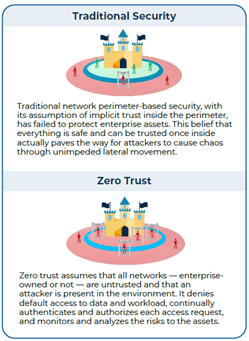
At its core, Zero Trust (ZT) is a security framework based on the principle of “never trust, always verify.” Unlike traditional network security models that rely heavily on perimeter defenses—a “castle and moat” model as seen in the image at the right—ZT assumes that threats can come from both outside and inside the network anytime, anywhere, and by anyone.
It advocates for the continuous verification of users, devices, and applications, ensuring that no entity is trusted by default, regardless of whether it resides inside or outside the organization’s perimeter.
The new Federal Zero Trust Data Security Guide specifically outlines the importance of Privacy Preservation Techniques and Tools as a critical means to protect sensitive information, prevent inadvertent disclosure of PII, preserve privacy, minimize the risk of data breaches, and align with the core tenants of ZT. ZT data security aligns with the data-centric approach to security, which places emphasis on data encryption and specifically, encryption of data in use.
The Guide specifically states: “Use robust encryption methods to protect data at rest, in transit, and in use to prevent unauthorized access even if the data is compromised.” Paperclip SAFE is the only privacy preserving technology that encrypts data in all states—at rest, in transit, and in use—while working at the speed of business.
Encryption-in-Use: What Does It Mean?
Encryption-in-Use refers to the protection of data while it is being actively processed or accessed. Unlike traditional encryption mechanisms that focus on encrypting data when it is at rest (stored data) or in transit (data being transferred), encryption-in-use ensures that sensitive information remains protected during its most vulnerable state—when it’s being actively utilized by applications or users. In short, if the servers are running, and the hard drives are spinning, the data is in use (no longer at rest) and must be encrypted.
Implementing encryption of data-in-use is crucial for several reasons:
- Data Security Across Environments: With the proliferation of cloud computing and hybrid infrastructures, data often moves between various environments. In these dynamic settings, encryption-in-use ensures that data remains protected even when it’s actively being processed within potentially untrusted environments.
- Mitigating Insider Threats: One of the biggest threats in the Zero Trust model comes from insiders who already have access to parts of the system. By encrypting data during use, the data itself is protected, making it nearly impossible for unauthorized personnel—even those with access to internal systems—to read, manipulate, or exfiltrate sensitive information.
- Regulatory Compliance: Many industries are governed by strict regulations that require the encryption of sensitive data throughout its lifecycle. Federal guidelines, including those incorporated within the Zero Trust Data Security Guide, are aligning with this demand by emphasizing encryption of data-in-use as a necessary control that must be included in most compliance standards.
Why Encryption is Critical to Zero Trust
ZT principles are designed to reduce the risk of data breaches and unauthorized access through continuous monitoring, strict access controls, and verification mechanisms. The Federal ZT Data Security Guide emphasized the use of data-centric security controls, such as encryption, to secure data at every level, in every location. Encryption of data-in-use helps achieve this goal by ensuring that sensitive data is protected even when it is being processed, further tightening security within the ZT model.
- Encryption Supports Least-Privilege Access: One of Zero Trust’s core principles is granting the least amount of access necessary. Encryption of data-in-use extends this concept by ensuring that data is only accessible in a usable form by only those who are authorized to access it and only under the right conditions. For instance, if data is encrypted during processing, even if an attacker gains access to an application, they will not be able to read or modify the data without the proper decryption keys.
- Continuous Monitoring with Encryption: ZT involves constant monitoring of users’ activities and the devices interacting with the system. Encryption of data-in-use enhances this monitoring by ensuring that sensitive data remains encrypted, even during operations. If an anomaly occurs, such as an unauthorized request to decrypt data, ZT systems can immediately flag and block the operation, preventing potential data leakage.
- Micro-Segmentation with Data Protection: Micro-segmentation is another essential part of the ZT model, which divides the network into smaller, isolated zones to limit access and lateral movement. Encryption-in-use adds an additional layer of security to this segmentation by ensuring that data within each micro-segment remains encrypted during processing, even if an attacker compromises one segment. This means that an attacker cannot move laterally within the network and gain meaningful access to data unless they break through additional layers of encryption.
The New Standard
The Zero Trust Data Security Guide’s emphasis on encryption of data-in-use is a timely and crucial step toward building robust, resilient data security frameworks. By aligning ZT principles with encryption techniques, organizations can create a comprehensive defense strategy that protects data in all stages, including operational data.
With the adoption of ZT principles such as data-centric security and Encryption-in-Use, organizations can significantly enhance their cybersecurity posture, reduce risks, and ensure regulatory compliance in a rapidly evolving threat landscape.
Learn more about Paperclip SAFE Encryption-in-Use technology which incorporates micro-segmentation, access & authentication, and active user modeling by visiting paperclip.com/safe or emailing us directly at contactus@paperclip.com.
See the full Federal Zero Trust Data Security Guide on our website.